OpenGate unifies the entire IoT stack—device management, connectivity, edge processing, automation, security, and analytics—into a single, extensible platform. This means faster deployments, less overhead, and safer operations, especially for heterogeneous, large-scale, or industrial setups.
OpenGate is a comprehensive IoT and IIoT platform developed by amplía))), designed to enable intelligent, secure, and scalable management of connected devices and other entities. Its modular and multiprotocol design allows it to integrate with any type of sensors or entities regardless of the manufacturer and adapt to industries like smart grid, utilities, renewable energy, telecom, manufacturing automation, agriculture, logistics, or smart cities.
🚀 Key Highlights
OpenGate stands out for several cutting-edge features that make it a next-level IoT platform. Here are some highlights:
Multi‑protocol, multi‑vendor architecture: Supports a wide range of technologies (Sigfox, NB‑IoT, LoRa, MQTT, CoAP, Modbus, SCADA) without vendor lock-in
Low-code rules engine: Allows creation of custom workflows and business rules via intuitive GUI, ideal for fast adaptation
Custom dashboards & visual wizards: Users can design interfaces and execute tasks through guided tools
Mass & remote device management: Centralized firmware updates, diagnostics, and bulk operations
Full enterprise integration: RESTful APIs for seamless connection to BI tools, ERPs, CRMs, and core systems
Edge Computing with integrated AI: Enables data processing at the network edge, reducing latency and improving responsiveness, with AI modules for predictive analytics and automation
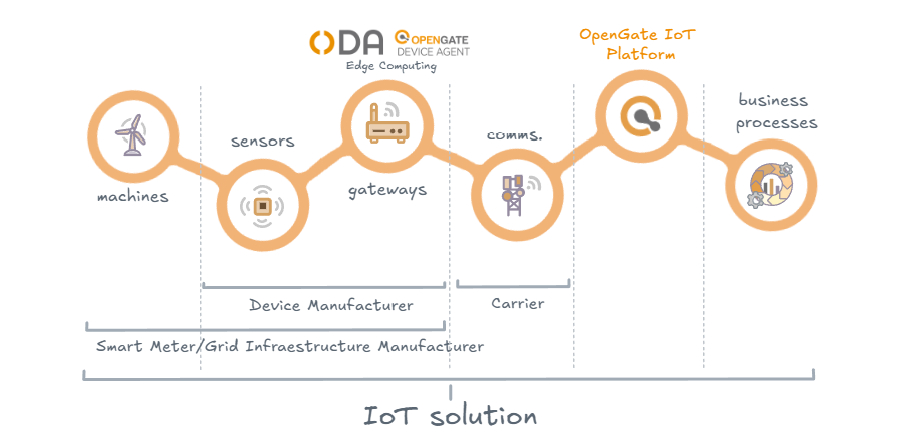
🌐 Position in the IoT Value Chain
OpenGate covers the complete IoT lifecycle:
At the edge, it ingests data from sensors and gateways and offers its OpenGate Device Agent (ODA)
In connectivity or comms, it manages SIMs and support for LPWAN protocols like NB‑IoT, LoRa, Sigfox and others
In the core Opengate IoT Platform, it handles device lifecycles, rule-based automation, multi-tenant isolation, offers data analysis using AI and is based on robust security
In the business processes, it exposes bidirectional data integration via RESTful APIs for interaction with BI, ERP, CRM, and other systems—enabling intelligent, scalable IoT ecosystems or business processes
🆚 Compared to Other IoT Platforms
Compared to other IoT platforms, OpenGate offers:
A hybrid edge–cloud architecture in one platform for high critical solutions and infrastructures, including advanced analytics capabilities at the edge
Broader protocol support, including LPWAN and industrial protocols that other platforms don’t include by default
A low-code GUI rules engine, versus script-based or function-based. This feature is integrated in the product
Native custom workspaces and dashboards and visual wizards, without needing external tools and allowing to use low-code to fully personalize them
Built-in bulk device management, versus separate modules on other platforms
Multi-tenant microservices, flexible deployment, and strong security—all provided out of the box
Private instance option, it is possible to deploy your own OpenGate cloud instance or even install it on premises on your own infrastructure
Other platforms from high positioned vendors (like AWS or Azure) excel in cloud-native breadth and analytics but generally require more complex assembly (e.g., Lambda, Greengrass, Power BI). OpenGate, by contrast, is optimized for heterogeneous industrial environments with hybrid deployment needs
✅ Why Choose OpenGate?
Modular & future-proof: Vendor-agnostic, edge-ready, adaptable to any industry
Enterprise-grade: Multi-tenancy, security, and lifecycle management ready to deploy tens or millions of devices
Operational efficiency: Bulk provisioning and automated workflows using API connectors reduce manual load
Developer & integrator friendly: REST APIs and JS extensibility, ideal for full-stack integration and customizations
Out-of-the box solution: Predefined sections, widgets, and catalog rules and operations to work with your data and devices from the first login
Low-code friendly: GUI wizards deliver fast configurations for technical and non-technical users
OpenGate architecture
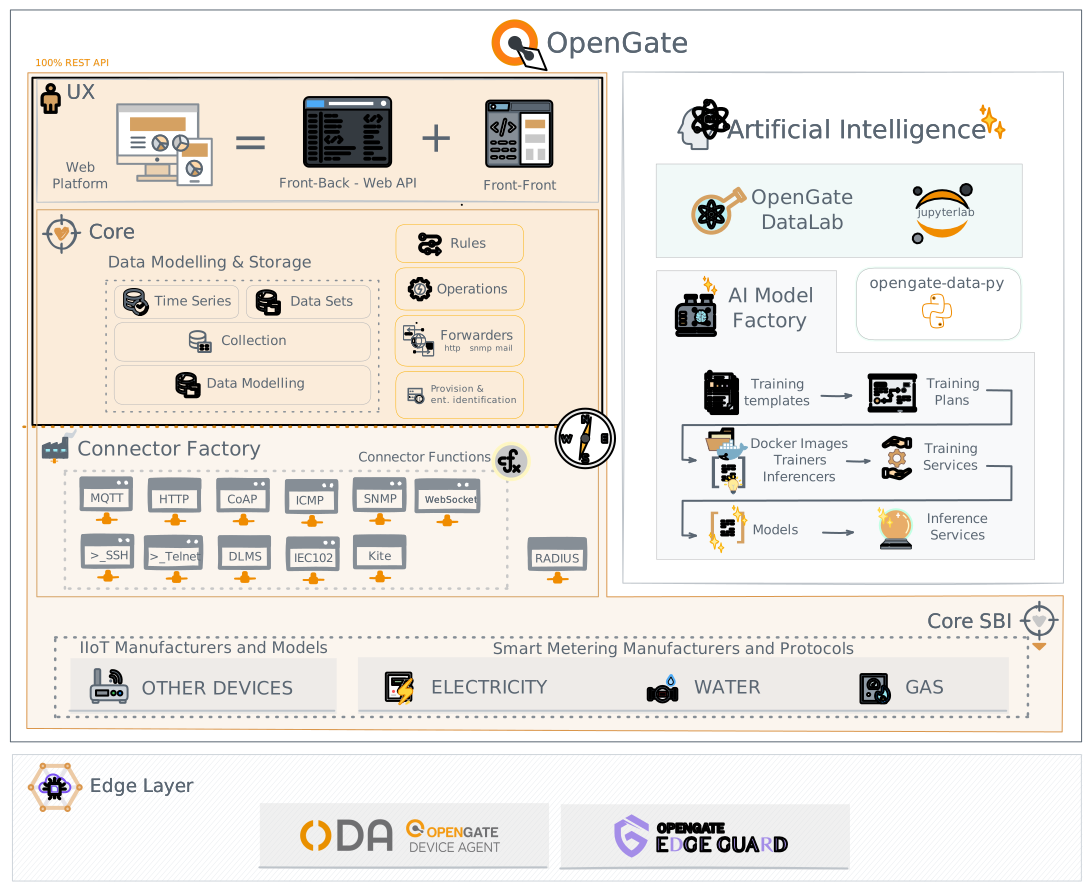
OpenGate Architecture Overview
OpenGate’s architecture is designed to be modular, scalable, and highly interoperable, making it ideal for managing complex IoT and IIoT ecosystems. Here’s a technical breakdown of its core components and how they interact:
From the OpenGate architecture perspective we like to talk about a journey from south to north, where south are devices or monitored entities and where north is the OpenGate IoT Platform and its capabilities. The following sections go deeper in each component
1. Core SBI (Southbound Interface)
This layer comprises sensors, actuators, and gateways in the field or the Edge. Devices communicate via various protocols like: Sigfox, LoRa, NB‑IoT, Modbus, SCADA, or MQTT—feeding data into the platform through the connector factory.
On-site, it is possible to deploy the OpenGate Device Agent (ODA) which runs lightweight edge processing: data collection, normalization, command execution, and optional AI capabilities. This local computation reduces latency and supports autonomy for critical IIoT solutions and also allows communication with non-IP-based protocols like Zigbee, RS-232, RS-485, and other, to OpenGate.
🏗️ Smart Metering devices
As part of the amplía))) commercial strategy, for the last years our tech team works harder to integrate different Smart Metering Manufacturers protocols and devices.
The following table summarizes the currently integrated manufacturers:
⚡Electricity
💧Water
🔥Gas
ELPRO
Amper WM‑Bus Concentrator
Pietro Fiorentini [cf(x)]
ITRON
Hidroconta
SagemCom [cf(x)]
ACTARIS
ContaZara
Watertech [cf(x)]
BAER
Spark [cf(x)]
Spark [cf(x)]
ELSTER
UT‑NOXIUM
SIEMENS
SagemCom
LANDIS‑SIEM_METERING
ORBIS
Xiamen Four‑Faith
SACI
ZIV
USYSCOM
STG Prime
NOTE: cf(x) means that this manufacturer is integrated using OpenGate Connector Functions
IMPORTANT : The devices on the table are the most used devices by our customers and new devices can be integrated using the standard ConnectorFunctions capabilities or through our professional services. You just need to ask us.
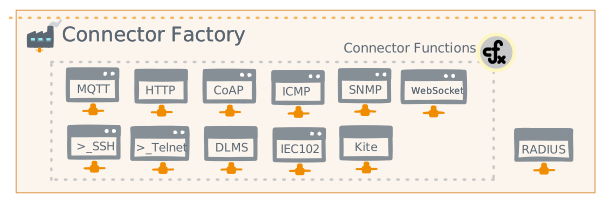
2. Connector Factory & Network Connectivity Layer
From the Network connectivity, secure transport of data from edge to cloud is managed here. OpenGate supports multiple network and communication channels including SIM-based networks for NB‑IoT and LTE-M, LPWAN (Sigfox, LoRa), and IP protocols (HTTP, MQTT, CoAP). This layer ensures encrypted, bi-directional connectivity, with VPNs (as special request), firewalling, load balancing, and SIM/LPWAN lifecycle management. This SIM lifecycle management is integrated as part of the OpenGate IoT Platform capabilities thanks to our mobile communications providers connectors like Kite.
🔌 Integration Without Limits
OpenGate’s Connector Factory is a cornerstone feature designed to simplify and accelerate integrations in complex IoT ecosystems. It empowers organizations to seamlessly connect external systems, ML/AI pipelines, device fleets, communications services, and more—without needing extensive coding efforts. This layer offers a Plug and play with pre-built connectors for critical systems and services:
SIM / LPWAN management as mention before, via our mobile communication providers connectors, fully integrated with mobile provider networks—simplifying device provisioning and subscription monitoring
Industrial gateways & protocols, including HTTP, MQTT, CoAP, Modbus, and other protocols, facilitating smooth data ingestion from field hardware
Enterprise visibility through BI, ERP, CRM, and cloud applications, thanks to robust HTTP connectors that break down data siloes instantly and allows you to centralize and enrich data gathered in OpenGate or send to another of your business core services
These connectors guarantee secure, two-way communication and are configured visually via the OpenGate UX layer, GUI Web Console
🛠️ Connector Functions
When out-of-the-box doesn’t cut it, Connector Functions - cf(x) let you tailor data flows in minutes using simple JavaScript:
Define criteria—select which messages should trigger your function.
Write logic—parse, enrich, transform, filter, or redirect data to external systems or devices.
Test & deploy—switch effortlessly between Disabled, Test, or Production modes.
Reuse and evolve—import/export configurations or access centrally managed catalog APIs to clone and maintain across environments
📈 Why this Makes the Difference
Speed-to-market: Achieve real-time integrations in hours, not weeks, using pre-built connectors
Custom-savvy: Craft advanced data workflows and transformations with minimal development effort and directly from web console
Centralized integration management: Visualize and control every connector (both standard integrations and Connector Functions) in a unified admin interface
Reusability & deployment consistency: Enable, disable, clone, or update your connector functions with a few clicks, reducing manual errors and enforcement friction. Ideal for CI/CD pipelines and ensuring replicable, version-controlled deployments
3. Core Platform
The OpenGate Core is the brain of the OpenGate IoT platform, and it’s designed to handle the full lifecycle of connected assets for your solution.
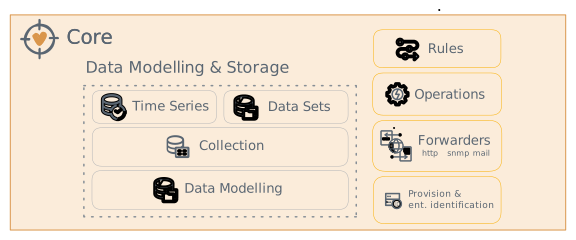
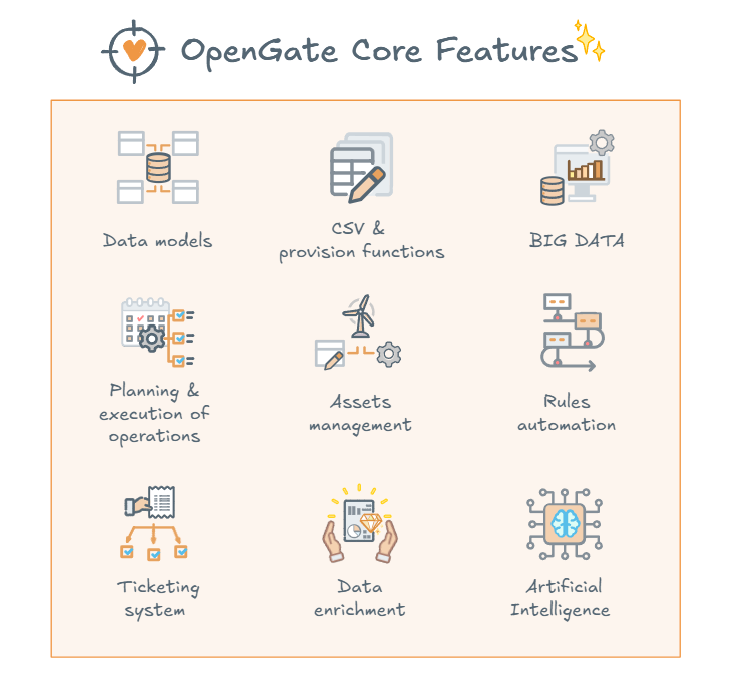
In short, OpenGate Core is particularly well-suited for organizations that need end-to-end control, real-time bidirectional response and broad device compatibility without being locked into a single vendor or cloud provider. Its main capabilities are organized in different areas as the next diagram shows:
📦 Data Modeling & Storage
Your entities, your data and your own way. OpenGate offers the possibility to adjust the data collected to your needs and desirable data structure:
Data Modeling: Design flexible schemas for your devices and assets, defining entity types and specific types, data streams, and metadata ensuring structured, consistent data throughout the lifecycle. Use our predefined catalog or create your own
Collection Data Lake: Ingest high-volume data in real time into a robust Data Lake organized using your data models and work with this raw real-time information to explore your entities data
Time Series and Data Sets: Use built-in tools to filter, aggregate, and construct time bucket based “Time Series” for your entities, and Create “Data Sets” for your entities based on the data collected for a custom data view of your entities status information. Use this data structures to build custom dashboards using the OpenGate widgets catalog
This capabilities enable efficient storage and retrieval of historical data with minimal effort, reducing overhead and enhancing analytics readiness.
⚙️ Provisioning & Entity Identification
Tools to help you to populate your devices and digital assets:
Provision tools & Provision Functions: Quickly onboard devices—individually using guided UI flows or custom JavaScript functions to automate validation, multi-entity creation, and configuration steps using low-code javascript powered capabilities.
Entity Identification Service: Automatically generate and assign unique IDs to each device or entity, ensuring reliable tracking and simplified maintenance and detect differences between provisioned and collected data automatically.
Entity types out-of-the-box: Build relationships and define detailed digital twins of your entities by using our devices and assets, and collect the communication modules information using our subscription and subscriber entity types.
Thanks to these tools, you can reduce manual errors, accelerate deployment, and maintain clean inventories even at industrial scale.
⚙️ Operations Engine
OpenGate’s Operations Engine empowers you to automate essential device and asset unitary or massive operations with full control and visibility:
Schedule remote tasks like firmware updates, diagnostics, and routine checks
Trigger operations on-demand (e.g., reboot a device, collect logs) or schedule them
Coordinate custom multi-step workflows tied to asset lifecycles
Create your own operations wizards directly from the OpenGate web console using JSON schema forms
The Operations Engine enables safe, repeatable actions across fleets without manual intervention, supported by execution logs and retry mechanisms for unitary or masive operations.
🧩 Rules Engine
Craft intelligent, real-time automation using the powerfull OpenGate Rules Engine:
Easy Mode GUI: Build rules using our conditional logic visually (“if-this-then-that”) without coding expertise
Advances Low-code GUI: Write advanced rules with custom processing, filters, and business logic using our predefined functions catalog or crafting your own. Start from scratch or use a basic catalog rule as template to build your own
Instant triggers and alerts: Respond to anomalies, thresholds, or patterns as they happen and trigger alerts, notifications or operations from the Operations Engine as response
These capabilities offers adaptive, responsive IoT automation, combining ease of use with full developer control for customizations.
🔁 Forwarders
Ensure data, events, and alerts flow seamlessly into your enterprise systems or enrich your OpenGate Data:
Bidirectional communication with third-parties and services
Route information from data streams or rule outputs to external systems (ERP, BI, CRM, custom APIs)
Choose sync or async delivery, including JSON, XML, or custom formats
Configure via GUI or code for flexible integration needs
We want OpenGate to be Your MultiTool but sometimes you need something else, so the forwarders offers you end-to-end operational workflows, eliminating the need for separate middleware and keeping business data in sync.
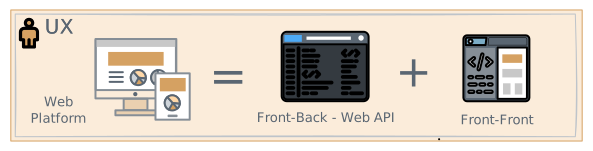
4. OpenGate UX Web Console
OpenGate’s web console is meticulously crafted to balance simplicity for end-users with depth for technical teams, offering a unified interface to manage devices, data, rules, analytics, and integrations, all without deep technical training and ensuring your User Experience.
Use the powerful tools from the OpenGate’s web console to build your own IIoT solution using a predefined catalog with more than 50 customizable widgets to create the specific views for your users or your needs and take advantage of the following capabilities:
🎛️ Customizable Workspaces & Dashboards
Select from different look and feels, upload your logos and customize the OpenGate appearance to meet your brand requirements
Create your own workspaces tailored for specific needs or roles such as operators, analysts, or admins
Use +50 customizable widgets to build your dashboards like charts, maps, tables, and entity lists to help you visualize the IoT ecosystem
Personalize your dashboards with filters, layouts, refresh intervals, and interactive controls
Use low-code snippets to make visual adjustments and visualization conditional rules depending on data values
Share your workspaces and dashboards within your organization with user groups o specific users
Integrate new features from external resources thanks to the custom menu areas using our secure iFrame functionality
🧭 Guided Wizards & Low-Code Tools
Step-by-step wizards guide users through complex tasks like creating dashboards, provisioning devices, and defining rules—no coding needed
Low-code tools let technical staff to configure advanced tasks, rules and customizations using javascript
🔒 Role-Based Access
Centralized GUI for user & role management, enforcing permissions across the platform
Define access policies for each workspace, feature, or dataset—ensuring data confidentiality and auditability
Create your own roles to define specifically who do what
Create your own multi-tenant organization to manage different levels or verticals from the same OpenGate organization
⚙️ Operational & Provisioning Interfaces
Real-time device inventory with status indicators, clickable controls, and firmware/update scheduling from a unified screen
Bulk operations managed through intuitive panels: filter, select, and apply actions to vast fleets effortlessly
↔️ Integration & Forwarding Configuration
Built-in UI elements to configure Connector Functions, Forwarders, and API endpoints—fully managed via intuitive dialogs
View logs and status of data forwarding and rule executions directly in the console
🧩 Developer-Friendly Debugging & Visualization
Live logs and data previews within each widget and rule/connector configuration
Test and debug Connector Functions or Rules directly in the interface before going to production
🎮 OpenGate Device Emulator
The Device Emulator is an essential tool within the OpenGate UX, enabling you to emulate device behavior instantly. This is a perfect tool for testing integrations, connector functions and rules, or debugging setups, or showcasing the platform without physical hardware and without additional tools. This gives you:
Simulate data flows without connecting real devices which is ideal for development teams, QA, or demos
Validate device provisioning and collection, rule triggers, forwarding logic, and dashboard visualizations
Validate complex workflows and simulate device operation responses
Accelerate your development by eliminating hardware procurement delays and issues by simulating device behavior in the cloud
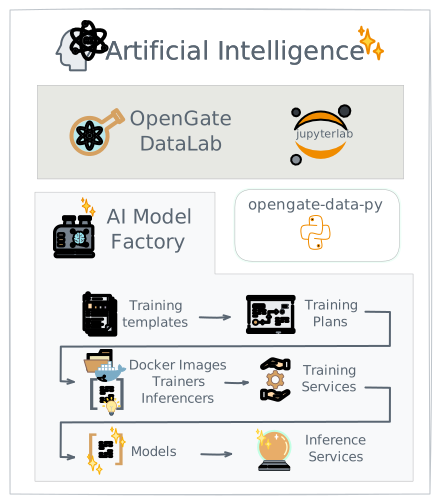
5. Artificial Intelligence
OpenGate’s AI layer brings advanced analytics and machine learning directly into the platform core, enabling seamless data-driven insights and automated decision-making. It’s designed for both data scientists and developers as well as operations teams. Key components include:
🐍 OpenGate Data Py
Our opengate-data is OpenGate’s official Python client library that simplifies data interaction across the platform:
📦 Data extraction & injection: Pull collections, timeseries data, DataSets, and entities directly into Python workflows and reinyect the result data again in OpenGate
💡 Perfect for notebooks: Integrates with Jupyter (Data Lab) for data exploration, visualization, and other tasks
⚙️ API-first approach: Easy full support for REST-based authentication, querying, and batch operations in Python
📓 OpenGate Data Lab
OpenGate Data Lab embeds Jupyter Notebooks into the platform with features like:
Notebook execution: Run notebooks manually or on a schedule as part of your data pipelines or workflows
Full Python ecosystem: Support for scientific libraries like NumPy or Pandas
Operational workflows: Combine data processing and analytics in a single interface that live within OpenGate using Opengate Data Py library
🏭 AI Model Factory (roadmap)
Our “AI Model Factory” is the next-gen module for end-to-end AI lifecycle within OpenGate featuring:
Pipeline orchestration: Design sequences involving data extraction, transformation, training and inference
Multi-format model support: Deploy and serve models for real-time predictions
Training & retraining: Include model training pipelines to continuously update models with fresh data
Inference services: Deploy models as services callable from the OpenGate Rules Engine for real-time decision-making
This fully integrated setup lets you build, train, serve, and manage AI models (traditional or ML models) directly within your IIoT environment
🔄 Cross-Cutting Concerns
Across all layers, OpenGate enforces:
Security: Encryption at rest/in transit, device integrity checks, tenant isolation, authentication, and auditing.
Monitoring & Logging: Central observability stack with metrics, tracing, alerting, and logs.
Hybrid Deployment: Suitable for fully cloud, fully on-premise, or hybrid edge‑cloud orchestration including AI capabilities.
Main features
🔍 OpenGate Core features
The OpenGate Core is the central engine of the OpenGate IoT platform, and it’s designed to handle the full lifecycle of connected assets. Its key capabilities include:
OpenGate Core stands out in the crowded IoT platform landscape by focusing on flexibility, edge intelligence, and seamless integration, especially for industrial and large-scale deployments.
In short, OpenGate Core is particularly well-suited for organizations that need end-to-end control, real-time responsiveness, and broad device compatibility—without being locked into a single vendor or cloud provider.
In essence, OpenGate Core acts as the brain of the platform—modular, scalable, and built to adapt to complex industrial environments.
🌟 OpenGate Features
OpenGate offers a rich toolbox of capabilities to help you to manage complex IoT ecosystems with security, scalability, and operational intelligence.
🔧 Device & Asset Management
Device inventory & digital assets
Maintain full control over your connected infrastructure, whether it’s a few devices or millions. Manage inventory, configurations, firmware, and real-time status—all from a centralized, secure console.
Mass operations & bulk provisioning
Scale operations effortlessly: onboard devices in bulk via intuitive wizards or Provision Functions, and execute mass firmware updates, diagnostics, or configurations across your fleet.
⚙️ Connectivity & Protocol Support
Vendor-agnostic connectivity
Seamlessly integrate LPWAN technologies like Sigfox, NB‑IoT, LoRa, SIM-based communication, plus IP protocols such as MQTT, CoAP, Modbus, SCADA—without vendor lock-in.
Secure bi-directional communication
Maintain robust, two-way communication between the platform and devices, ensuring status, commands, and updates flow efficiently and securely.
🤖 Edge Computing & Intelligence
Integrated agent (ODA)
Use the lightweight OpenGate Device Agent (ODA) on gateways and edge devices to collect, normalize, and transmit data—and to execute operations locally.
Edge processing & AI readiness(alpha)
Leverage edge computing to reduce cloud dependency and latency. Integrate AI-driven analytics and predictive processing directly at the edge—simplifying real-time decision-making.
📊 Custom Dashboards & Visual Wizards
Tailored workspaces & dashboards
Build visual workspaces with charts, maps, entity views, and more. The drag-and-drop dashboard layout allows non-technical users to craft custom displays easily.
Guided wizards & low-code configuration
Use visual wizards to execute complex tasks, operations, and configurations. The platform’s low-code rules engine enables fast business rule deployment without programming.
🔗 Rules Engine & Operations
Real-time rules & automation
Automate triggers—from simple alerts to complex multi-step operations—based on live data, with full GUI and JavaScript support.
Operations Scheduler
Schedule remote tasks, firmware upgrades, and diagnostics efficiently, using a built-in scheduling engine.
🔐 Security & Multi‑Tenant Support
End-to-end security
Security controls are built across all layers: device, connectivity, and data‑center. Includes encryption, access control, auditing, and secure firmware validation.
Multi‑tenant architecture
Manage multiple organizations, workgroups, and sub-tenants with complete isolation—supporting flexible governance and role-based access control.
🔁 Integration & API Access
Northbound RESTful APIs
Connect with BI tools, ERP/CRM systems, external applications or custom integrations using comprehensive REST APIs for management, data retrieval, analytics, and operations.
Connector module support
Enhance integrations with connector functions that bridge data from external systems or third-party services into OpenGate.
📈 Data Lake & Analytics
Time-series ingestion & visualization
Ingest high‑volume sensor data into a data lake. Use built-in modules to filter, aggregate, and visualize data for insights and trend analysis.
✅ Why These Features Matter
OpenGate unifies the entire IoT stack—device management, connectivity, edge processing, automation, security, and analytics—into a single, extensible platform. This means faster deployments, less overhead, and safer operations, especially for heterogeneous, large-scale, or industrial setups.
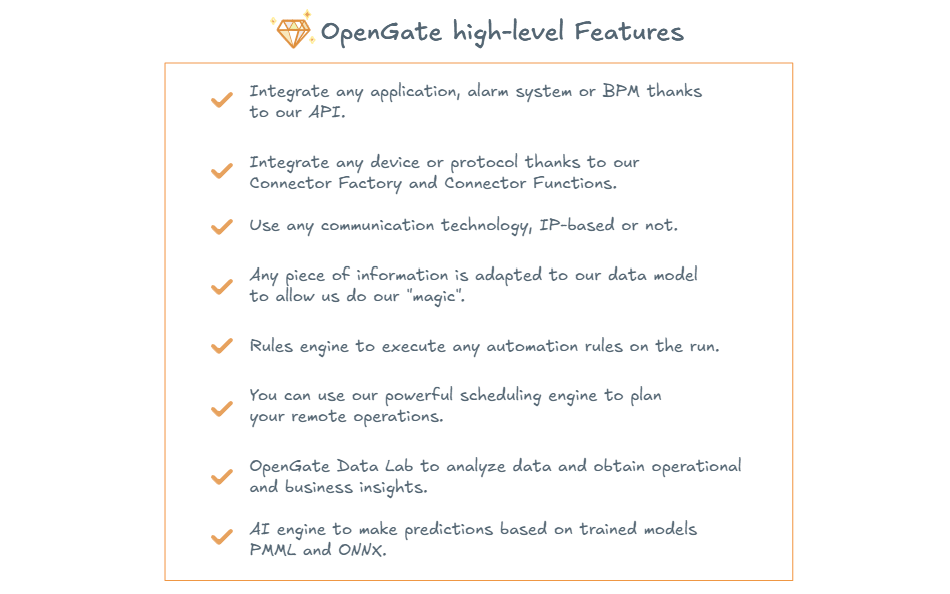 OpenGate stands out for several cutting-edge features that make it a next-level IoT platform. Here are some highlights:
 OpenGate covers the complete IoT lifecycle: