Custom Chart
Custom charts allow for the display of data in graphical format based on user-defined logic.
How it Works

Once the logic for data retrieval is entered, the data will be displayed on the widget.
What sets the custom chart apart from others is that the data source can be external, internal, both, or even fabricated. Moreover, multiple charts can be combined within the same widget.
This widget is compatible with eCharts library version 5. Multiple examples can be accessed via the following link: eCharts
Configuration
General
- Boxed: widget will be displayed with background in dahsboard.
- About: widget description in Markdown format.
- Title: widget title. It can be configured to remain fixed in the widget or only be displayed when it receives focus.
- Toolbar: configures the behavior of the widget bar on the dashboard, allowing you to hide it, hide it when not in use, or leave it always visible.
- Refresh Frequency: allows configuring the data refresh frequency displayed in the list.
- Extra actions: allows user to add new specific actions to the widget with your own code.
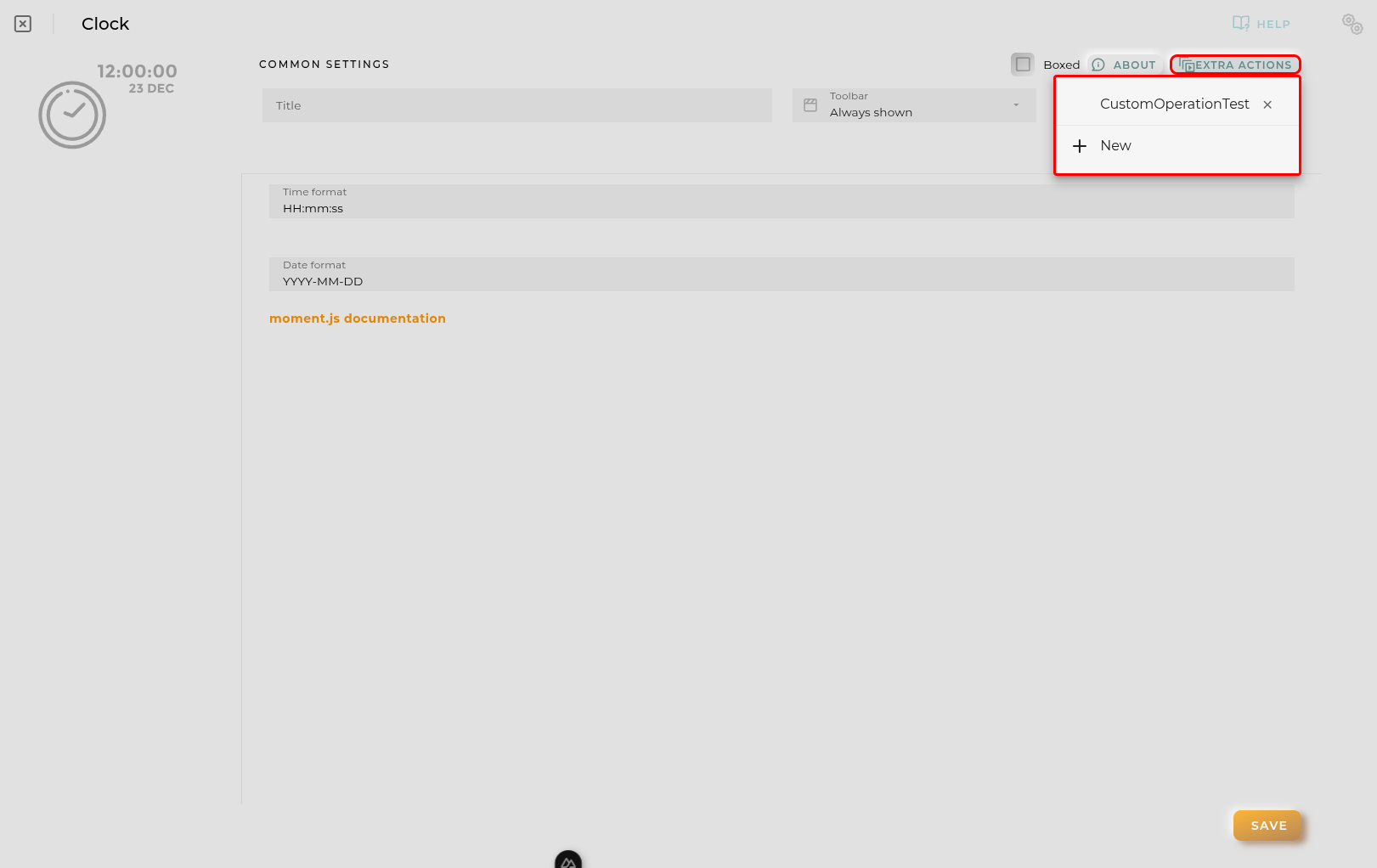
You can add a new one by pressing the New button.
Once you added a custom action it can be modified later by pressing the name in the list.
In order to remove the custom action click the delete icon button on the right.
In extra actions you can write your own code were you can open other dashboards, entities dashboards or execute wizards.
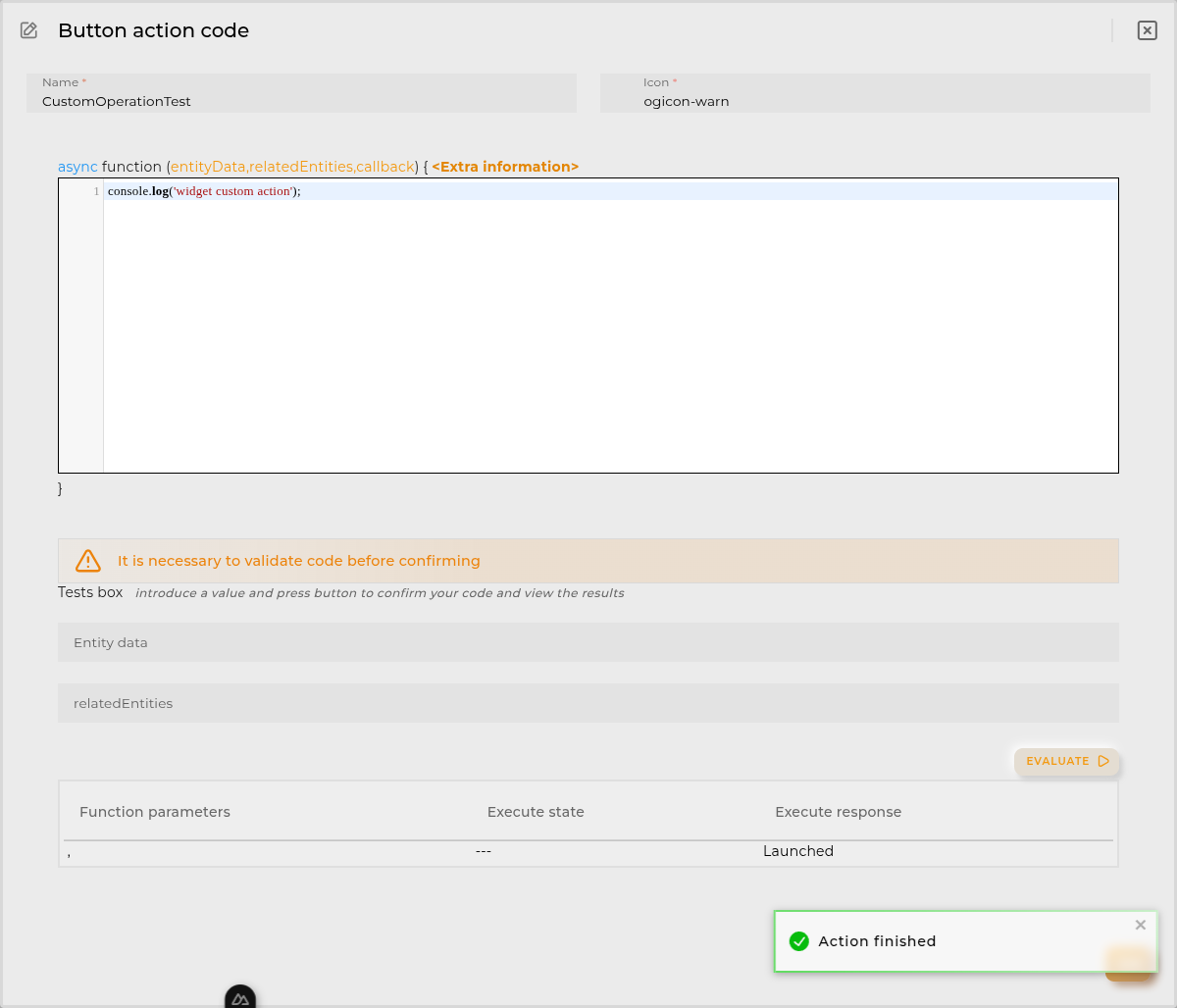
You can find all available functions and methods in Extra Information
- Show widget filters instructs the widget to display its filters. These filters will be passed as an additional parameter to the data retrieval function.

Here, you input the necessary code to obtain the information to be displayed.
Depending on the selected options, the parameters received by the function will be displayed.
The function must always return a JSON object that is compatible with eCharts’ chart configuration.
Every time the code is updated, it must be evaluated where a preview of the result can be seen.

Function
Depending of the configuration receives the following parameters:
- entityData contains the data of the opened entity NOTE: only available when the user opens an entity dashboard template
Example:
- relatedEntities contains an array of entities related to the entity selected. NOTE: only available when the user opens an entity dashboard template
Example:
- timeserieData contains info about the timeserie opened by the user
- config timeserie configuration
- data timeserie row selected
NOTE: only available when the user opens an entity dashboard template from timeserie table widget
An example:
- alarmData contains the data of the alarm opened in template
- dashboardFilters contains an object with the selected filters in the dashboard. Each property is related to a widget filter-property.
tasksSelected contains a list with tasks selected.
jobsSelected contains a list with jobs selected.
operationNameSelected contains a list with operation names selected.
operationStatusSelected contains a list with operation statuses selected.
operationResultSelected contains a list with operation results selected.
alarmNameSelected contains a list with alarm names selected.
ruleNameSelected contains a list with rule names selected.
alarmSeveritySelected contains a list with alarm severities selected.
alarmStatusSelected contains a list with alarm statuses selected.
Example:
- filters introduced by the user. These filters are:
- generic widget generic filter
- period widget date period filter
- inherit json object with inherited filter if ‘shared filter’ is enabled. This filter is composed by ‘and’ filter that contains standar filter, private/template filter and headers filters from the source widget.
An example:
- callback (optional) function used to send chart data (only when the api/http petitions are promised, use return instead)
or
or
Available utils
$api -> use it to create http petitions to OpenGate Api Rest doc
$user -> Logged user
Example:
$moment -> use it to format date doc
console -> display messages in navigator console
Promise -> allows easy execution of multiple promises
http -> javascript encapsulation of a useFetch (Nuxt 4) instance doc. Returns { data, error, status, refresh, clear } where data and error are reactive Refs.
echarts -> echarts core library
ecStat -> echarts stats library
addChartEvent -> (event, handler[(event, chartInstance) => {}] [, query]) - adds an event handler doc